

TCF POST Analysis
DHAKA – The world cotton market is navigating a challenging landscape in the current 2026/27 marketing year, despite tightening supply of the raw fiber and a surge in its consumption to a six-year high of 121.7 million bales.
Being the main textile and apparel manufacturing hub of the world, Asia is the biggest market for global exporters, while some Asian countries are recalibrating their procurement strategies to manage shifting trade patterns, price volatility and domestic problems in industries and productions
Regional Import Trends and Outlook
Analysis of the latest report of the United States Department of Agriculture interprets that while global cotton trade is expected to see a slight contraction, major Asian hubs continue to drive the market.
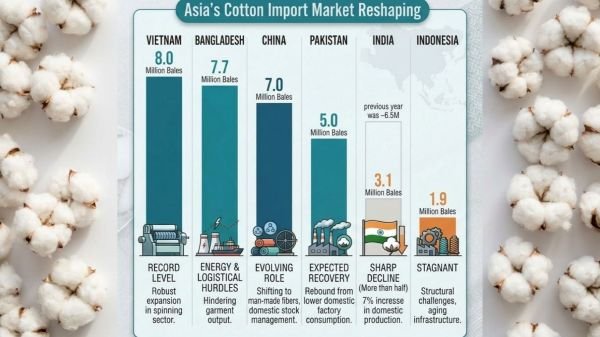
- Vietnam: Forecast to reach a record level of 8.0 million bales in 2026/27, Vietnam is positioned as a leading global importer, supported by a robust expansion in its cotton yarn spinning sector.
- Bangladesh: For 2026/27, imports are forecast at 7.7 million bales. The industry is currently contending with significant energy supply shortages, logistical hurdles, and economic instability that have hindered ready-made garment output.
- China: Raw cotton imports are projected at 7.0 million bales. China’s role is evolving as it shifts toward man-made fibers and domestic stock management, though it remains a central pillar of global consumption.
- Pakistan: Imports are expected to recover to 5.0 million bales in 2026/27, driven by a rebound from lower domestic factory consumption in the previous marketing year.
- India: India’s import demand is forecast to drop by more than half compared to the previous year. This sharp decline is primarily attributed to a projected 7% increase in domestic production, allowing the country to rely more heavily on its own ample supplies.
- Indonesia: Imports remain stagnant at 1.9 million bales, a level nearly 50% below the record set in 2017/18. The sector continues to face structural challenges, including aging infrastructure and stiff competition from synthetic alternatives.
- Cambodia: A smaller player in the raw cotton import landscape, with a very small spinning sub-sector, Cambodia’s textile manufacturing is currently under pressure from softer external demand and rising energy costs, which may temper its immediate import growth.
Market Drivers and Future Outlook
The global cotton market is currently influenced by several structural shifts:
- Production Declines: Global cotton production is forecast to fall 5% to 116.0 million bales in 2026/27, driven by smaller crops in the U.S., Brazil, China, Pakistan, and Turkey.
- Price Volatility: With global consumption projected to outstrip production, ending stocks are expected to drop to 71.8 million bales. Analysts warn this tighter balance is likely to increase price volatility throughout 2026.
- Synthetic Competition: Although cotton faces consistent competition from synthetic fibers, recent oil supply shocks have increased production costs for polyester, providing cotton with a modest, albeit pressured, price advantage in the coming months.